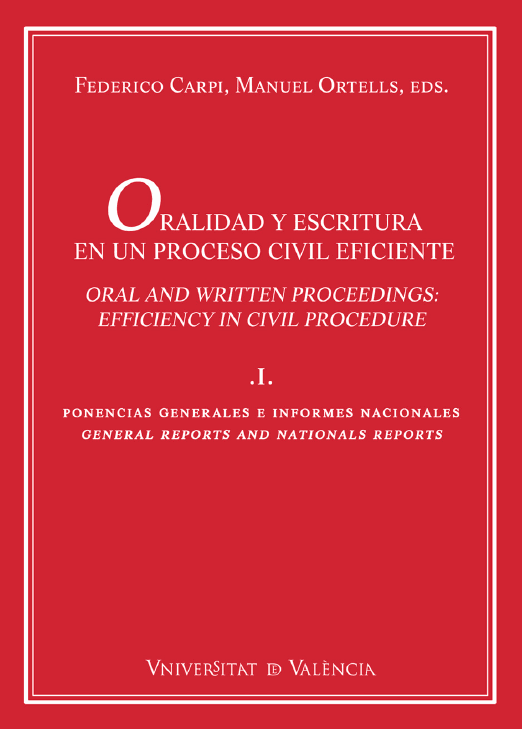
Twelfth International Colloquium Vol. 1

Valencia and Gandia, 2008 Orality and writing in efficient civil proceedings. Vol. I


Twelfth International Colloquium Vol. 1

Title (Original / English):
Oralidad y Escritura en un Proceso Civil Eficiente / Oral and Written Proceedings: Efficiency in Civil Procedure

Editors: Federico Carpi; Manuel Ortells Ramos

Year: 2008

Publisher: Universitat de Valencia

Volume: I

Language: Spanish, with some contributions in English

Organizing Institution: International Association of Procedural Law (IAPL)


Summary

Context and Purpose

  • The document represents the proceedings of the IAPL Colloquium held in Valencia, Spain.
  • Focuses on the balance between oral and written procedure in civil justice systems globally, emphasizing efficiency, accessibility, and the modernization of procedural law.
  • Highlights the Spanish legal tradition and comparative perspectives from civil and common law systems.
  • Explores the evolution of civil procedure under technological, social, and constitutional influences, including telematics and secondary orality in modern courts.

Preface and Introduction

  • Preface (Federico Carpi):
    • Introduces the historical context of procedural law in Spain and Europe.
    • Discusses the philosophical and practical debate on orality versus written procedure.
    • Highlights Italian, German, and Spanish procedural scholars and traditions.
    • Emphasizes procedural efficiency, case management, proportionality, and the role of judicial discretion.
    • Notes the significance of the Tribunal de las Aguas as an exemplar of efficient oral proceedings.
  • Introduction (Manuel Ortells Ramos):
    • Provides rationale for selecting the colloquium theme and Valencia as the location.
    • Connects the discussion to constitutional guarantees of oral proceedings in Spain.
    • Presents the central thesis: an effective civil justice system requires a flexible balance of oral and written proceedings to maximize speed, fairness, and quality.
    • Introduces technological impact on procedural methods, including document management, video testimony, and electronic filing systems.
    • Outlines the structure of the volume: introductory reports, general reports, and national reports from various jurisdictions.

Structure and Sections

1. Introductory Reports

  • Víctor Fairén Guillén – The oral and efficient process before the Valencian Water Tribunal:
    • Provides a detailed historical and functional analysis of the Tribunal de las Aguas.
    • Highlights principles of orality, concentration, publicity, authority, minimal documentation, rapid decision-making, and enforceability.
    • Describes the tribunal's governance, the role of experienced community members as judges, and procedural rituals dating back to the 13th century.
    • Emphasizes efficiency, low cost, voluntary compliance, and cultural legitimacy.
  • Marcel Storme – More voice, less print:
    • Argues in favor of increasing oral elements in civil proceedings to enhance speed and procedural clarity.
    • Discusses comparative perspectives between oral traditions in common law and written traditions in civil law.

2. General Reports

  • Dieter Leipold – Oral and written elements within the introductory phase of civil procedure:
    • Analyzes the initial phase of civil proceedings and the strategic role of written submissions versus oral hearings.
    • Explores efficiency, case management, and judicial discretion.
  • Soraya Amrani-Mekki – Impact of new technologies on civil procedure:
    • Examines how telematics, electronic filing, and video hearings alter procedural norms.
    • Discusses opportunities for efficiency without compromising fairness or transparency.
  • Jorge W. Peyrano – Evidence between orality and writing:
    • Focuses on how evidence is presented in oral vs. written formats.
    • Discusses reliability, procedural economy, and the impact on judicial decision-making.
  • Michele Taruffo – Orality and writing as factors of efficiency in civil litigation:
    • Highlights empirical research on time, cost, and quality in oral and written procedures.
    • Discusses proportionality, procedural simplification, and the role of concentrated hearings.

3. National Reports

  • Spain (Alicia Armengot Vilaplana):
    • Describes constitutional and statutory frameworks for oral proceedings.
    • Highlights local practices and procedural innovations.
  • England & Wales (Stefan Einhaus):
    • Emphasizes case management reforms, pre-trial conferences, and the limited but growing role of oral hearings.
  • Japan (Manabu Honma):
    • Discusses hybrid systems with strong written traditions complemented by oral hearings.
  • Korea (Junghoo Oh):
    • Examines procedural modernization, court efficiency, and reforms promoting oral testimony.
  • Greece (Dimitris N. Maniotis), USA (Jakob Reinhard), Latin America (Pía Tavolari Goycoolea), China (Hongliang Wang):
    • Each report provides country-specific procedural norms, comparative observations, and efficiency strategies.
  • Italy, Brazil, Peru, Colombia, Germany, Venezuela, Uruguay, Chile, Argentina, Mexico:
    • Detailed examinations of civil procedural systems, highlighting orality, efficiency, and reforms.
    • Includes discussions on concentrated hearings, use of technology, procedural simplification, and integration of customary practices.

Key Themes

  1. Orality vs. Writing:
    • Evaluates the trade-offs between oral hearings and written submissions.
    • Focus on concentration, immediacy, transparency, and fairness.
  2. Efficiency in Civil Procedure:
    • Methods to reduce duration, cost, and procedural complexity.
    • Emphasis on proportionality, case management, and judicial discretion.
  3. Comparative Law Perspectives:
    • Contrasts civil law and common law systems.
    • Explores hybrid procedural solutions and lessons from international experience.
  4. Technological Innovation:
    • Role of electronic filing, video hearings, and digital evidence.
    • Concept of secondary orality: oral communication mediated by technology.
  5. Customary and Historical Examples:
    • The Valencian Tribunal de las Aguas serves as a living model of oral, efficient, and culturally grounded civil justice.
  6. Judicial Principles:
    • Orality, concentration, publicity, authority, simplicity, enforceability, integrity of judges, community legitimacy.

Notable Case Study – Tribunal de las Aguas

  • Historical roots: Established 13th century, continuous operation for over 800 years.
  • Procedural characteristics:
    • No formal written record during proceedings; decisions issued immediately.
    • Judges chosen for integrity and practical knowledge of community water issues.
    • Public hearings, concentrated arguments, oral evidence, rapid adjudication.
    • Enforcement via social compliance, minimal administrative intervention.
  • Significance: Demonstrates principles of procedural efficiency, fairness, community legitimacy, and minimal reliance on formal documentation.

Tags

  • Oral proceedings
  • Written proceedings
  • Civil procedure efficiency
  • Case management
  • Proportionality
  • Comparative law
  • Technological innovation
  • Telematics
  • Secondary orality
  • Tribunal de las Aguas
  • Customary jurisdiction
  • Procedural simplification
  • Evidence presentation
  • Judicial discretion
  • Concentrated hearings

IAPL Reporter

Social Media

Follow IAPL on Social Media